Excellent Content Cannot Fix Every Technical SEO Problem, and Perfect Technical SEO Cannot Fix Irrelevant Content
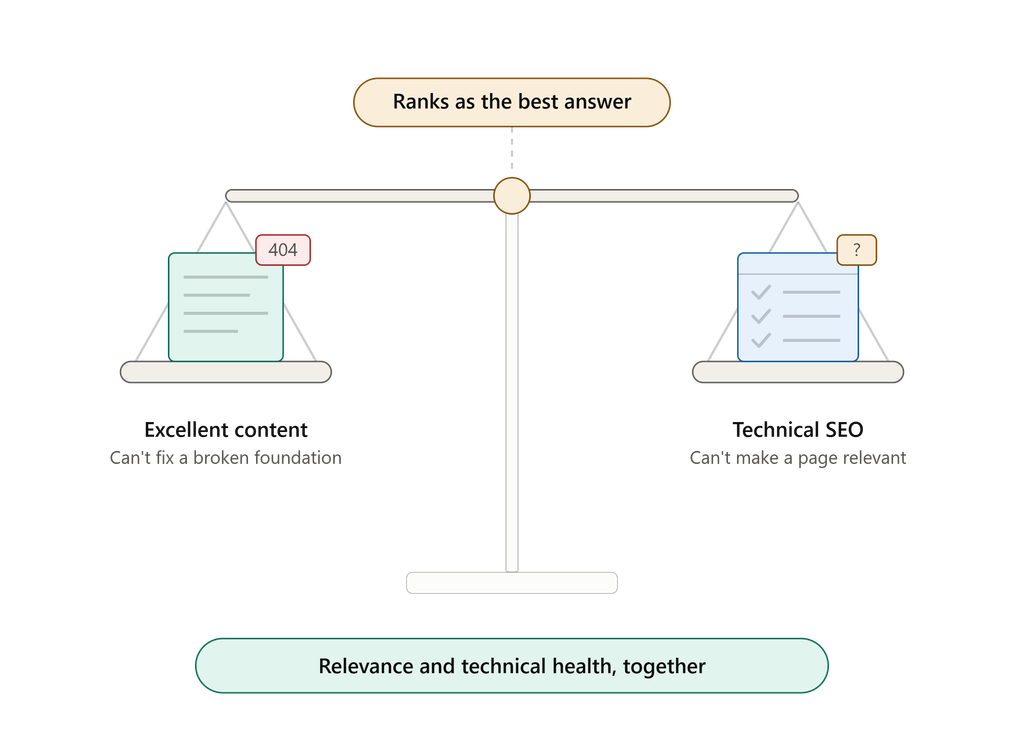
Excellent content cannot compensate for every technical problem, and perfect technical SEO cannot make an irrelevant page the best answer.
This is the balance many SEO and content strategies get wrong. Some websites invest heavily in content production while overlooking technical issues that prevent important pages from performing. Others focus on technical audits, page speed, structured data, and crawlability without asking whether their content actually satisfies the searcher’s needs.
Both approaches leave a gap.
A page can contain useful insights, accurate information, original research, and clear explanations yet struggle to gain organic visibility because search engines cannot access or index it correctly. Another page can meet every technical requirement and still fail to compete because it does not answer the query, match search intent, or provide enough value to the reader.
The solution is not to choose between content and technical SEO. It is to understand what each contributes, identify the actual performance bottleneck, and make sure neither one undermines the other.
Content vs Technical SEO
| SEO factor | Content SEO | Technical SEO |
|---|---|---|
| Primary purpose | Satisfy search intent and provide useful information | Help search engines access, crawl, understand, and index pages |
| Main focus | Relevance, quality, accuracy, and usefulness | Crawlability, indexability, performance, and site architecture |
| Keyword research | Identifies target queries, related terms, and user needs | Helps organise URLs and ensure important pages are accessible |
| Search intent | Ensures content answers the user’s actual question | Supports the delivery and accessibility of relevant pages |
| Content structure | Uses clear headings, logical sections, and useful explanations | Supports navigation, internal linking, and a logical site hierarchy |
| Page speed | Keeps content readable and avoids unnecessary page elements | Improves loading performance and addresses technical bottlenecks |
| Internal linking | Connects related topics and guides readers to useful resources | Helps search engines discover pages and understand site relationships |
| Indexing | Provides meaningful content that may qualify for inclusion in Search | Manages indexing directives, canonical URLs, and crawl access |
| Structured data | Ensures page information is accurate and suitable for markup | Implements valid structured data where appropriate |
| User experience | Makes information clear, relevant, trustworthy, and easy to follow | Supports mobile usability, responsiveness, and stable page layouts |
| Common problems | Keyword stuffing, shallow content, outdated information, and intent mismatch | Broken links, accidental noindex directives, redirect errors, and incorrect canonicals |
| How to measure | Relevance, organic clicks, query performance, engagement, and conversions | Crawl and indexing reports, Core Web Vitals, server responses, and technical audits |
| Main limitation | Cannot independently resolve serious technical barriers | Cannot make irrelevant or unhelpful content the best answer |
| Desired outcome | Give users the information they need | Make valuable pages accessible and easy for search engines to process |
Why Content Quality and Technical SEO Depend on Each Other
Content and technical SEO solve different problems within the same search process.
Content quality determines how effectively a page addresses a topic, answers a question, explains a process, or helps someone make a decision. Technical SEO helps search engines discover, crawl, interpret, and index the page as intended.
Neither discipline replaces the other.
Consider a comprehensive article explaining how local SEO services work. It covers Google Business Profile optimisation, local search visibility, customer reviews, local citations, and the factors that influence Google Maps rankings. The article is accurate and genuinely useful, but an accidental noindex directive prevents it from being indexed.
The content may satisfy the searcher’s needs, but a technical configuration prevents it from competing in search results as intended.
Now consider a technically sound local SEO service page. It loads quickly, has descriptive metadata, uses appropriate structured data, and includes relevant internal links. However, it offers little information about the service, explains no process, provides no meaningful evidence of experience, and fails to address what potential customers want to know.
The technical foundation is strong, but the page gives visitors few reasons to trust it or choose the service.
These examples demonstrate the relationship clearly: technical SEO helps make valuable content accessible, while content relevance and usefulness give the page a reason to appear for a particular search.
1. Great Content Cannot Overcome Every Technical SEO Problem
Publishing a strong article is not the end of the SEO process. Search engines must still be able to discover the URL, access its content, process its indexing instructions, and understand its relationship to the rest of the website.
When technical problems interfere with these processes, content improvements alone may not solve the problem.
Crawlability and indexability
Crawlability concerns whether search engines can access a page. Indexability concerns whether they can include it in their search index.
A page may struggle to gain visibility because of:
- An accidental
noindexdirective. - Incorrect robots.txt rules that block necessary crawling.
- Canonical tags pointing to the wrong URL.
- Broken internal links or orphan pages.
- Server errors that prevent reliable access.
- Redirects that lead to irrelevant destinations.
These problems require technical investigation.
For example, rewriting a well-researched article will not correct a canonical tag that identifies another URL as the preferred version. Adding more keywords will not resolve a server error that prevents Google from accessing the page.
Before investing time in a major content rewrite, confirm that the intended URL can be accessed and indexed correctly.
Page speed and user experience
A useful page should also be easy to access and read. Slow loading, unresponsive interactions, unstable layouts, and difficult mobile navigation can create friction for visitors.
Google’s Core Web Vitals measure important aspects of real-world page experience, including loading performance, responsiveness, and visual stability. These metrics help identify usability problems, although passing every threshold does not guarantee higher rankings.
The right response is to investigate the underlying causes. Oversized images, unnecessary JavaScript, inefficient rendering, and slow server responses may all contribute to performance problems.
Content teams do not need to remove valuable explanations simply to make an article shorter. Technical teams should instead look for ways to improve delivery while preserving the information readers need.
Duplicate URLs and weak site architecture
A website can also create unnecessary complexity through duplicate URLs, poorly managed redirects, inconsistent canonical tags, or several pages targeting nearly identical search intent.
Search engines can handle many duplicate-content situations, so duplication does not automatically produce a penalty. However, unclear URL signals and overlapping pages can make it harder to establish which page should serve a particular query.
Internal linking matters here, too. Important pages should receive relevant links from appropriate sections of the website. This helps visitors navigate related information and gives search engines additional ways to discover and understand those pages.
A technically healthy website is not simply one without errors. It is one that makes important content accessible and organises it in a way that supports both users and search engines.
2. Perfect Technical SEO Cannot Make Irrelevant Content Useful
Technical optimisation can remove barriers to search visibility, but it cannot replace the substance of a page.
A technically sound website can still struggle when its content fails to answer the main question, misses the searcher’s intent, or repeats information without adding meaningful value.
Search intent determines what the page needs to explain
Search intent describes what someone wants to accomplish when they enter a query.
For example, someone searching for an international SEO agency is probably evaluating providers or researching the services needed to expand into other markets. A useful service page should explain the agency’s approach to international keyword research, country-specific SEO, multilingual websites, hreflang implementation where relevant, and performance measurement across markets.
A page that repeats the phrase “international SEO agency” throughout its headings without explaining these concepts offers little practical value.
Likewise, someone searching for “how to improve Google Business Profile visibility” needs actionable guidance. A page that primarily promotes a digital marketing agency may not satisfy that informational intent.
The issue is not necessarily keyword usage. It is the gap between what the searcher expects and what the page delivers.
A stronger page answers the main question clearly, explains the relevant concepts, uses accurate examples, and addresses the decisions or problems that naturally follow.
Related keywords should support the explanation
Search engines use language-understanding systems, including RankBrain and neural matching, alongside other ranking systems to help interpret queries and connect them with relevant concepts.
This makes it useful to write about a subject comprehensively rather than relying on exact-match keyword repetition. However, there is no reliable universal formula that converts related terms or semantic coverage into a specific ranking score.
The practical approach is to identify the primary query, understand the search intent, and include related concepts when they help explain the subject.
For a page targeting “local SEO services,” relevant topics might include Google Business Profile optimisation, local citations, local landing pages, customer reviews, and local search visibility. Each concept should appear where it helps the reader understand the service or make a decision.
The objective is not to insert every related keyword. It is to provide the information that makes the page a genuinely useful answer to its primary query.
Technical signals cannot substitute for depth, accuracy, or trust
Structured data helps search engines interpret information about a page. Appropriate metadata helps describe its subject. Internal links help connect related resources.
None of these elements makes an inaccurate or unhelpful article authoritative.
A strong page should answer the main question, provide enough detail to solve the problem, and offer value beyond repeating information available everywhere. Depending on the topic, that may require original reporting, first-hand experience, expert input, verified examples, or careful analysis of reliable sources.
Content reliability matters because readers need to understand why they should trust the information. Important factual claims should be accurate and supported by appropriate evidence.
Technical SEO should support those qualities rather than distract from their absence.
3. Relevance, Distance, and Prominence: A Useful Example of the Difference
Local SEO illustrates why technical optimisation and content relevance must work together.
Google identifies relevance, distance, and prominence as the main factors associated with local search results. These factors help explain why a business can have a well-optimised website yet fail to appear prominently for every local query.
Relevance concerns how well a business matches what someone is searching for. Accurate business information, an appropriate Google Business Profile category, and useful service pages can help communicate that relevance.
Distance concerns how far a business is from the searcher or the location specified in the query. A business cannot use better content to eliminate a genuine geographic disadvantage.
Prominence relates to how well known a business is, informed by signals such as information Google has about the business across the web. Reviews, links, and other evidence of recognition can contribute to this picture.
A local SEO agency should understand these distinctions before promising improvements.
For example, a roofing company may have fast pages, clear service descriptions, and appropriate local landing pages. Those improvements can strengthen its website, but they do not guarantee the business will appear first in Google Maps for every nearby location.
The business also needs accurate profile information and genuine evidence of local operations and customer service. Its location relative to the searcher and its overall prominence remain relevant considerations.
This example reinforces the broader principle: optimise what you can control, demonstrate real value, and avoid treating any single optimisation as a guarantee of rankings.
4. Diagnose the Actual Problem Before Making Changes
When a page underperforms, the first question should not be whether to rewrite it or run another technical audit.
The first question should be: What is preventing this page from achieving its intended purpose?
A practical diagnosis starts with three checks.
Check whether search engines can access the page
Use Google Search Console and a reliable crawling tool to examine indexability, canonical tags, server responses, internal links, and relevant rendering issues.
If an important page cannot be indexed as intended, resolve the technical problem before assuming the content needs a complete rewrite.
Not every excluded URL requires a fix. Some pages should remain outside the index, so investigate whether the current configuration matches the site’s intended structure.
Check whether the page answers the target query
Review the primary search query and the intent behind it. Compare the page’s actual content with the information a visitor needs.
Ask:
- Does the introduction answer the main question?
- Does the page explain the subject thoroughly enough?
- Are important subtopics missing?
- Does it use accurate examples and reliable evidence?
- Does it address relevant comparisons, limitations, and next steps?
- Does it offer anything useful beyond repeating widely available information?
If the page is accessible but does not satisfy the query, content improvement may be the priority.
Check whether the experience makes the content easy to use
Review loading performance, mobile readability, navigation, layout stability, and internal links.
A page can contain the right information but still make it difficult to find. Clear headings, descriptive links, concise explanations, and a logical structure help readers reach the information they need.
These checks should work together. A page may have both technical and content problems, and fixing only one will not necessarily deliver the desired result.
5. How to Balance Content and Technical SEO
A balanced SEO strategy does not require an equal division of resources between content and technical work. It requires prioritising the issues that matter most to the website and its audience.
Step 1: Fix barriers that prevent valuable pages from performing
Start with important URLs affected by indexing problems, broken links, server errors, incorrect canonicalisation, or other serious technical issues.
Focus on pages that should be indexed and that serve a clear business or informational purpose.
Step 2: Map each page to a specific search intent
Assign every important page a primary query and a clear purpose. Group related queries when they satisfy the same intent, and separate them when they represent a genuinely different need.
This reduces unnecessary overlap and helps ensure that every page has a reason to exist.
Step 3: Improve existing content where it offers the greatest opportunity
Do not assume that publishing more articles is always the best way to grow organic traffic.
Review existing pages for missing information, outdated claims, weak examples, unclear explanations, and overlapping topics. Update or consolidate pages where doing so creates a more useful resource.
Avoid expanding an article simply to reach a particular word count. The appropriate length depends on the question and the detail required to answer it.
Step 4: Improve the page experience
Make the content fast, readable, accessible, and easy to use on mobile devices. Optimise images, review unnecessary scripts, improve navigation, and add contextual internal links.
Use performance measurements to identify real problems instead of chasing scores without understanding their practical value.
Step 5: Evaluate results using relevant data
Monitor indexing, impressions, clicks, search queries, average positions, and conversions where applicable. Use analytics and technical reports to understand changes in performance.
If rankings decline after a site update, investigate the affected URLs and compare the timing of the decline with the implementation. Do not automatically blame content quality or technical SEO without supporting evidence.
Search performance can change for several reasons, including competition, seasonality, search demand, content changes, and technical problems.
6. Why Content and Technical SEO Teams Need to Work Together
Content writers and technical SEO specialists often approach the same website from different perspectives.
Content teams focus on relevance, accuracy, usefulness, structure, and the needs of the audience. Technical teams focus on accessibility, crawling, indexing, performance, architecture, and implementation.
The strongest workflows connect these responsibilities.
Suppose a content audit identifies ten pages that receive little organic traffic. A technical review may reveal that three have indexing issues, four do not satisfy their target search intent, and the remaining three overlap with other pages.
Treating all ten as content problems would waste time rewriting pages that cannot perform as intended. Treating all ten as technical problems would overlook the content weaknesses that need attention.
A shared review helps teams identify the right action for each page.
This collaboration also improves future publishing. Content briefs can include relevant internal links, URL requirements, structured data considerations, and performance expectations. Technical audits can prioritise pages based on their search intent, business value, and role in the content strategy.
The objective is not to give one discipline more importance. It is to ensure both support the same outcome.
7. A Better Way to Think About SEO Performance
SEO is not a checklist in which completing enough technical tasks guarantees success. Nor is it a publishing exercise in which producing enough quality articles guarantees organic growth.
It is a system of connected requirements.
Search engines need to access and process pages. Pages need to satisfy relevant queries. Information needs to be accurate and useful. Websites need to provide a reasonable experience, while businesses must establish credibility and demonstrate value in their respective markets.
The relative importance of each factor varies by query, page type, website, and competitive environment. There is no reliable universal formula that converts these areas into an exact ranking score.
That uncertainty does not make SEO guesswork. It makes diagnosis, evidence, and prioritisation more important.
Instead of asking whether content or technical SEO matters more, ask which weakness is currently limiting the page and what evidence supports that conclusion.
Sometimes the answer is an indexing directive. Sometimes it is a weak explanation, an incorrect search-intent match, or a lack of original value. Sometimes several problems need attention.
The best strategy addresses those problems in the right order.
Final Thoughts
Excellent content cannot compensate for every technical problem, and perfect technical SEO cannot make an irrelevant page the best answer.
That is why successful SEO requires more than writing better articles or resolving technical audit warnings. It requires understanding how technical health, search intent, content quality, and user experience work together.
If search engines cannot access an important page, investigate the technical barriers. If the page is accessible but fails to answer the target query, improve its relevance and usefulness. If readers struggle to find or understand the information, improve the experience.
Use related keywords to explain the topic, not to inflate keyword density. Support important claims with reliable evidence. Publish resources that deserve attention because they answer real questions and provide meaningful value.
The goal is not technical perfection for its own sake or content production for the sake of volume.
The goal is to make valuable content accessible, relevant, trustworthy, and useful enough to deserve consideration in search results.
Content and technical SEO are not competing priorities. They are complementary parts of a strategy that works best when neither one holds the other back.
Frequently Asked Questions
Can good content rank without perfect technical SEO?
Yes. A website does not need to be technically perfect for every page to rank. However, serious problems with crawling, indexing, rendering, or accessibility can prevent valuable content from appearing in search results as intended.
Does technical SEO guarantee better rankings?
No. Technical SEO can resolve barriers and help search engines access and interpret a website. It does not guarantee rankings, particularly when a page fails to satisfy the searcher’s intent or provide useful information.
How do related keywords improve content quality?
Related keywords can reveal relevant subtopics, concepts, services, and questions that belong in an article. Their value comes from helping the page explain the subject comprehensively, not from inserting every variation or assuming that each term is a direct ranking factor.
Should I update content or fix technical SEO first?
Start with the most significant confirmed problem. If an important page cannot be indexed correctly, investigate the technical issue first. If the page is accessible but does not answer the target query, focus on content relevance and usefulness. Address both when necessary.
What makes an SEO article genuinely useful?
A useful article answers its main question clearly, provides enough detail to solve the reader’s problem, explains relevant subtopics, uses accurate examples, and supports important claims with reliable evidence. It should also be readable, easy to navigate, and free from unnecessary repetition.
Can Core Web Vitals improve rankings?
Core Web Vitals measure important aspects of page experience and can help identify performance problems. However, meeting the recommended thresholds does not guarantee higher rankings. Content relevance and other ranking considerations remain important.
Sources
Creating Helpful, Reliable, People-First Content – Google Search Central
2. How Google Search Works – Google Search Central
4. Understanding Page Experience in Google Search Results
5. SEO Starter Guide – Google Search Central
7. General Structured Data Guidelines – Google Search Central